


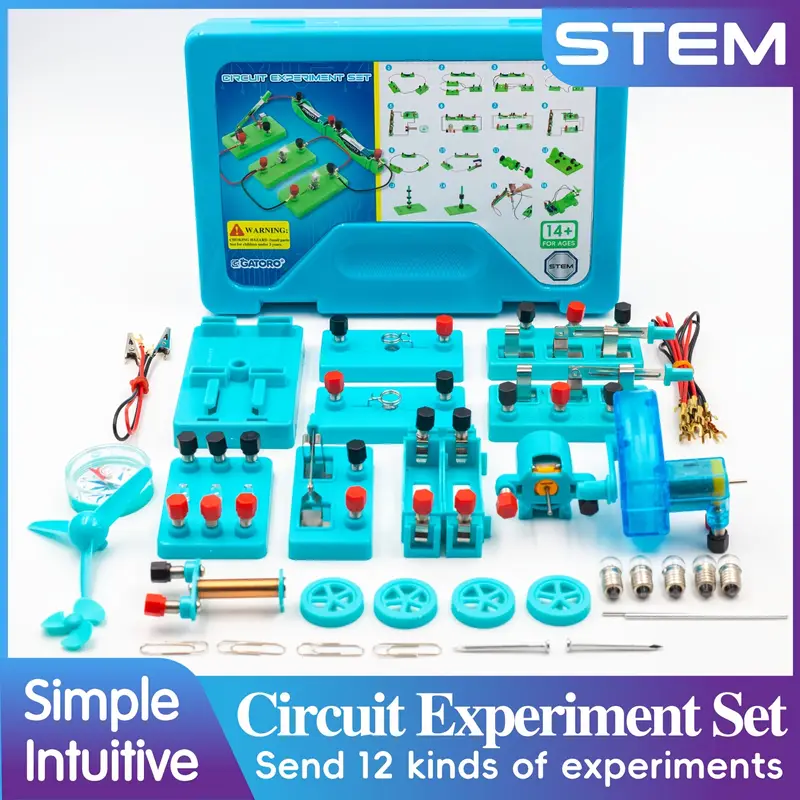
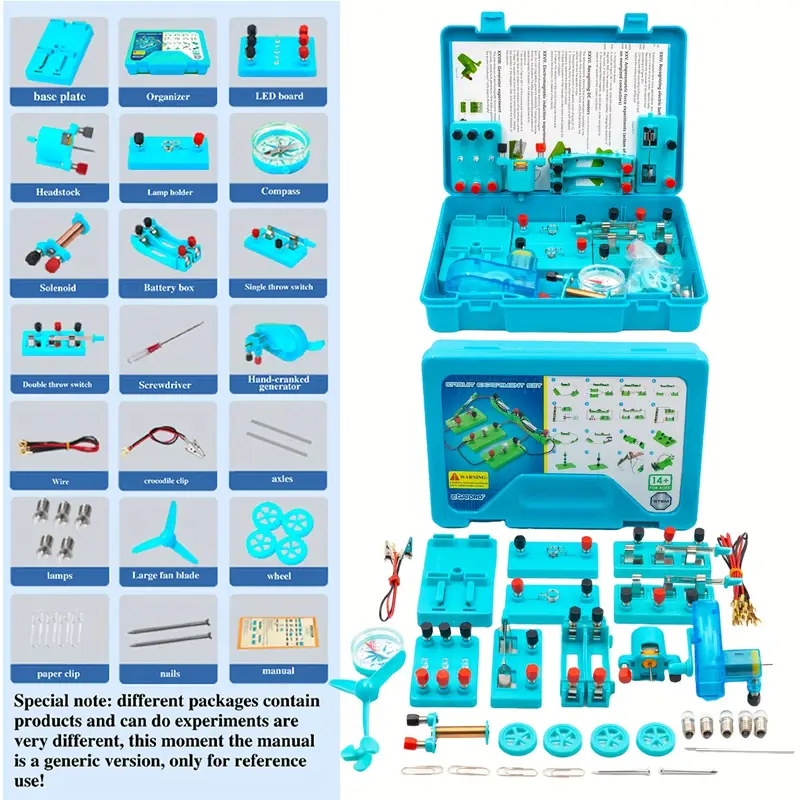
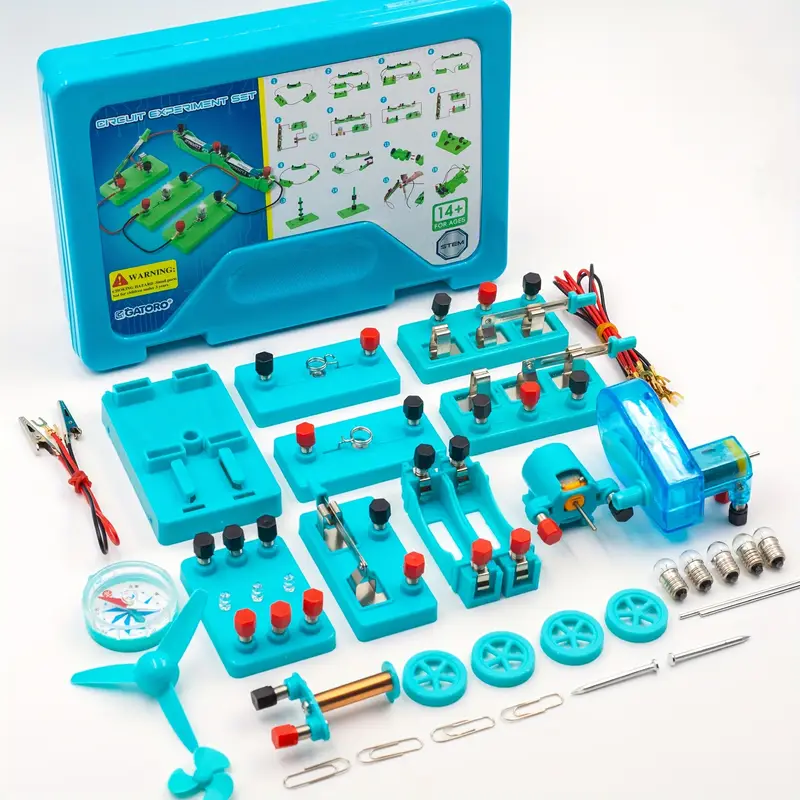
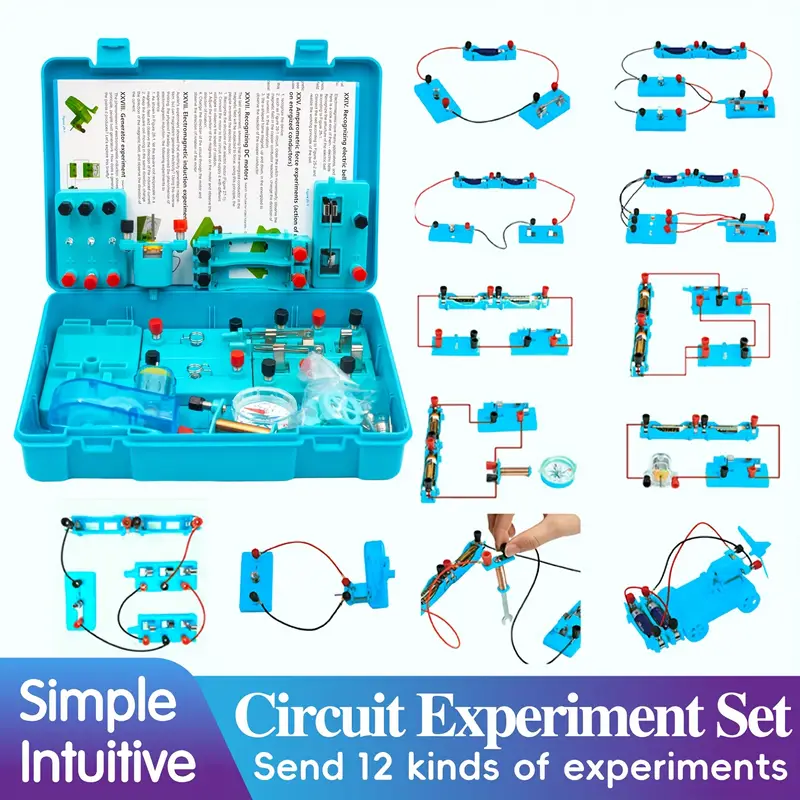
STEM Physics Experiment Kit Set for Teachers – Classroom Demonstration Set with LED Board, Motor, Fan, Compass – Educational Science Lab Supplies for School and Home – Includes English Guide – Blue
https://goods-vod.kwcdn.com/goods-video/77354bca1acc06be5a1db1c50731872e75db3c38.f30.mp4
Applicable age group: 14 years+ Main material: ABS (plastic) Color: Blue
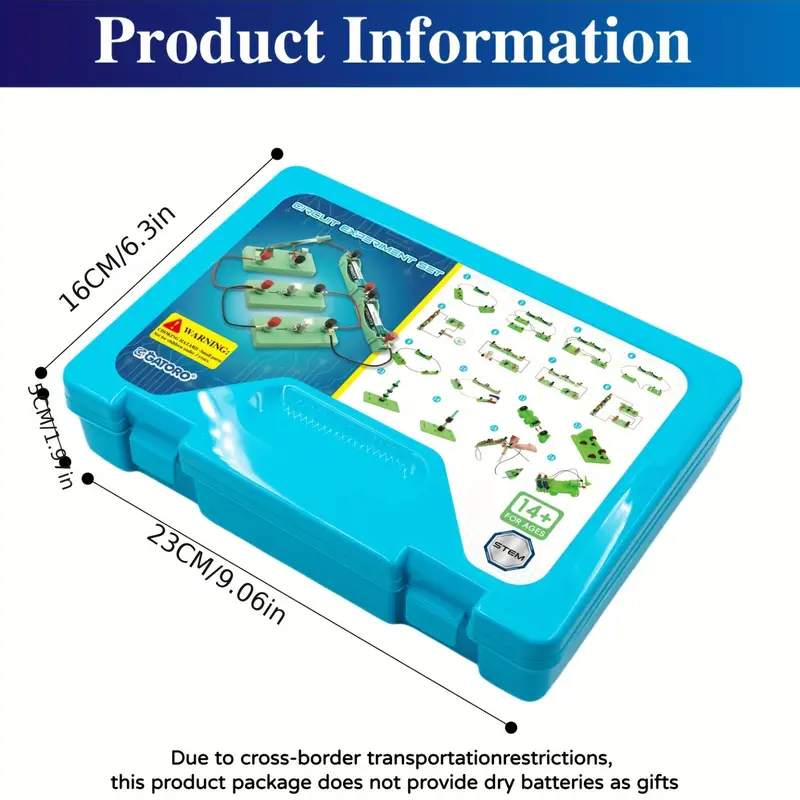
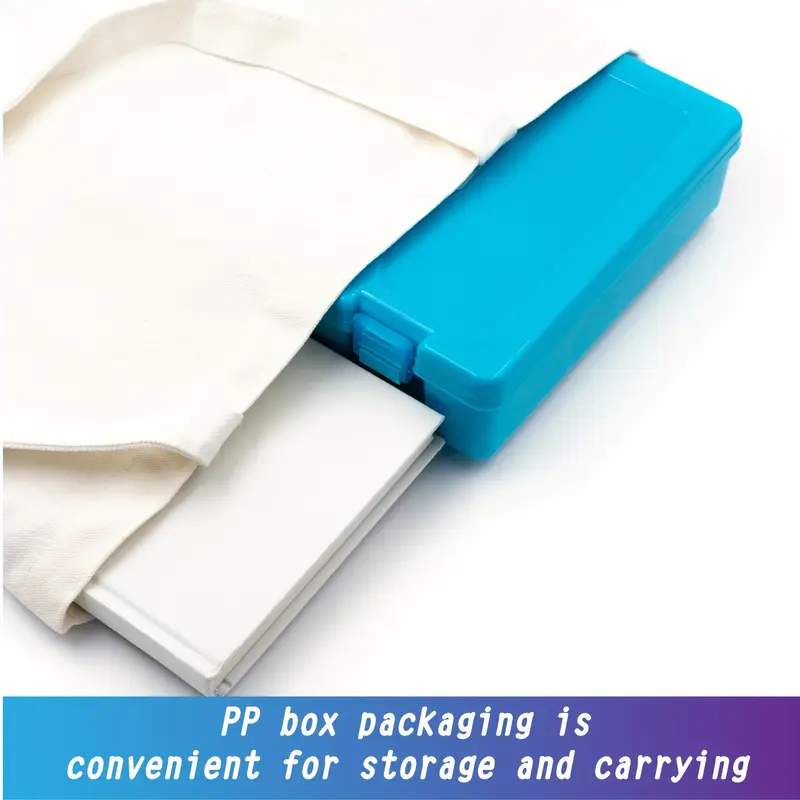
The equipment for the electrophysics laboratory is made of durable ABS plastic. It is packed in a storage box measuring 23 x 16 x 3 cm and weighs approximately 0.50 kg. Please note that 2 AA batteries are required for its operation (batteries are not provided). Live English manual for daily use.
Physical Electricity Experiment Box
Experiment 1: Simple Circuits
Learning Objectives
1, master the basic components of the circuit and the role of the components of what parts.
2, master the three states of the electric circuit: broken, through, short circuit.
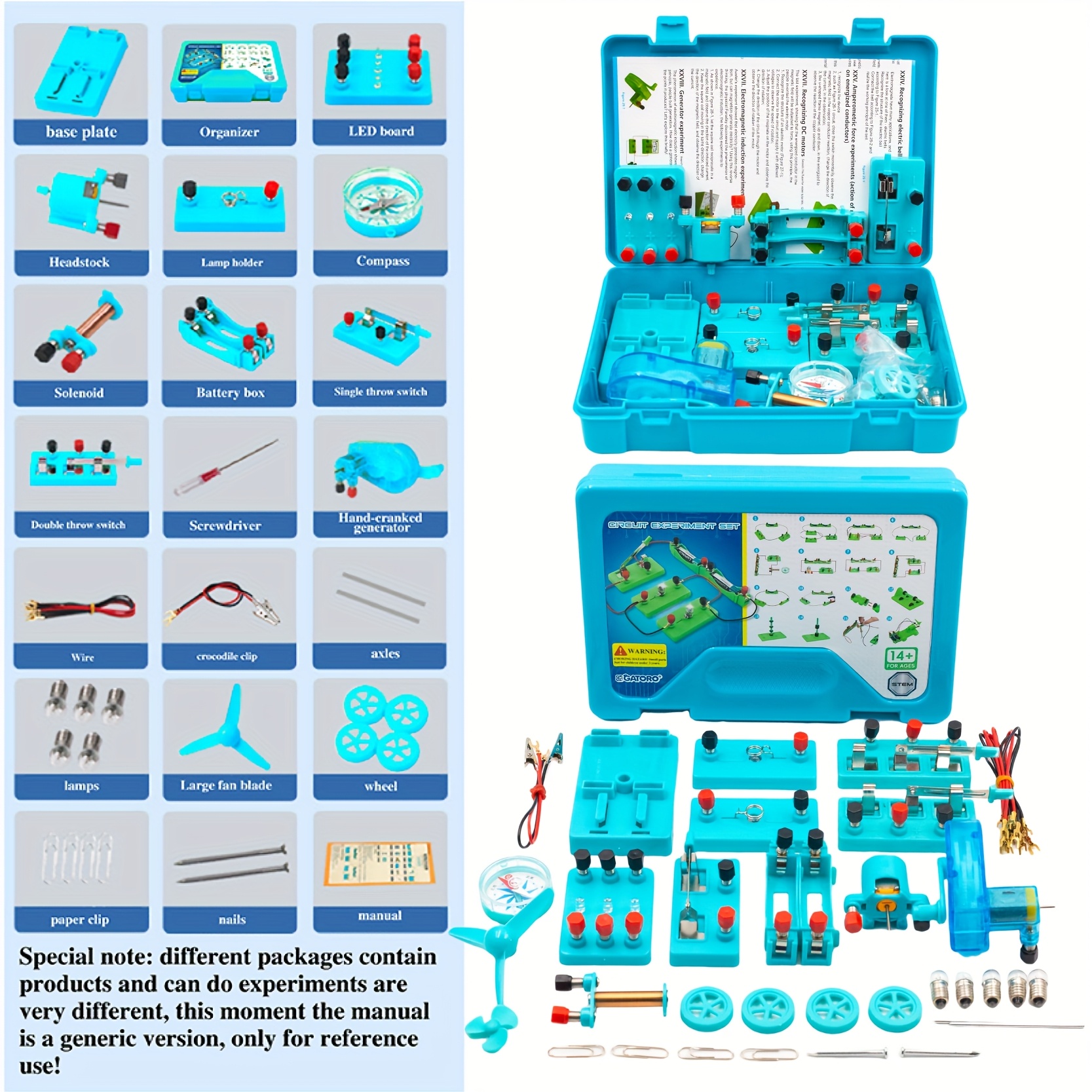
3, to understand the hazards of short circuits and the application of local short circuits.Equipment: battery box, batteries, switches, small lamp base, wire, small electric beadsOur families are often faced with a lot of electrical appliances, they are connected to a circuit inorder
to work, then how to form a circuit? What are the elements of a circuit? Let us use a small
lightbulb as an electrical appliance, do-it-yourself composition of the simplest circuit.Experimental design.
1, such as Fiqure 1-1 and Figure 1-2 to form a circuit, and close the switch to make the circuitwork, to understand what is through? What is a broken circuit? Think: the recent circuit hasthose parts of the composition, the role of each part is what?
Figure 1-1 Figure
Experiment 1: Simple Circuits
Learning Objectives
1, master the basic components of the circuit and the role of the components of what parts.
2, master the three states of the electric circuit: broken, through, short circuit.
3, to understand the hazards of short circuits and the application of local short circuits.Equipment: battery box, batteries, switches, small lamp base, wire, small electric beadsOur families are often faced with a lot of electrical appliances, they are connected to a circuit inorder
to work, then how to form a circuit? What are the elements of a circuit? Let us use a small
lightbulb as an electrical appliance, do-it-yourself composition of the simplest circuit.Experimental design.
1, such as Fiqure 1-1 and Figure 1-2 to form a circuit, and close the switch to make the circuitwork, to understand what is through? What is a broken circuit? Think: the recent circuit hasthose parts of the composition, the role of each part is what?
Figure 1-1 Figure
Experiment 2: Series and Parallel CircuitsLearning Objectives.
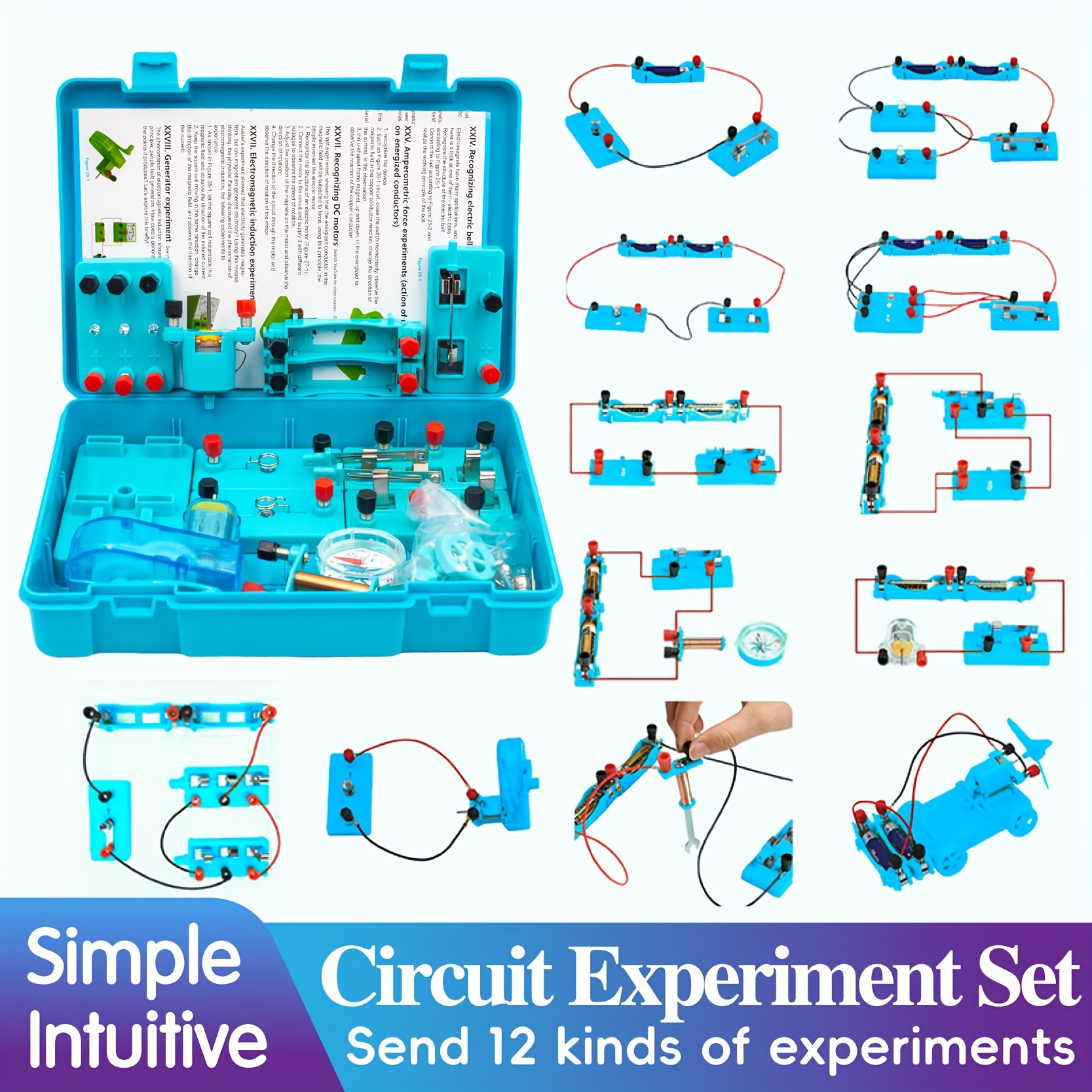
1、 Know what a series circuit is and can connect series circuits.
2, understand the basic characteristics of series circuits (path of current, switch position on
thecircuit)
3, know what is a parallel circuit, can connect the basic parallel circuit
4, understand the characteristics of parallel circuits, can distinguish between dry circuit,
branchcircuit, know the role of dry circuit switch and branch switch.Equipment: battery box,
batteries, switch, small electric beads, wire, small lamp base.We put a small electric bead
into the circuit to form a most basic simple circuit, but in real lifewe all have a lot of electrical
appliances into the agreed circuit, so how do we use electricalappliances into the same
circuit, then how can we access more than one electrical applianceinto the same circuit?
What are the connection methods?Below also let us use multiple small electric beads on
behalf of multiple electrical appliancesconnected to the circuit, see some of the connection.
1、 Know what a series circuit is and can connect series circuits.
2, understand the basic characteristics of series circuits (path of current, switch position on
thecircuit)
3, know what is a parallel circuit, can connect the basic parallel circuit
4, understand the characteristics of parallel circuits, can distinguish between dry circuit,
branchcircuit, know the role of dry circuit switch and branch switch.Equipment: battery box,
batteries, switch, small electric beads, wire, small lamp base.We put a small electric bead
into the circuit to form a most basic simple circuit, but in real lifewe all have a lot of electrical
appliances into the agreed circuit, so how do we use electricalappliances into the same
circuit, then how can we access more than one electrical applianceinto the same circuit?
What are the connection methods?Below also let us use multiple small electric beads on
behalf of multiple electrical appliancesconnected to the circuit, see some of the connection.
Experiment 3:Electromagnet ExperimentLearning Objectives.
1, know the structure and principle of electromagnet
2, know the size of the magnetism of the electromagnet andthose
factors.
3, to understand the application of electromagnets in a varietyof
occasions, solenoids energized after the remaining magneticfeld,
which is similar to the bar magnet, but the magnetic islimited, so
how to increase the solenoid’s magnetism? Let’sexplore the
following hands Experimental equipment: solenoid, battery box,
batteries, wire,nail
1, know the structure and principle of electromagnet
2, know the size of the magnetism of the electromagnet andthose
factors.
3, to understand the application of electromagnets in a varietyof
occasions, solenoids energized after the remaining magneticfeld,
which is similar to the bar magnet, but the magnetic islimited, so
how to increase the solenoid’s magnetism? Let’sexplore the
following hands Experimental equipment: solenoid, battery box,
batteries, wire,nail
Experiment 4:The Oster Experiment Learning Objectives.
1,know the Oster experiment and its signifcance.
2,know the current magnetic feld direction factors.
Experimental equipment: battery box, batteries, compass, switch
As shown in Figure 4-1 put the wire along the small magneticneedle
N,S pole direction on the small magnetic needleabove and then
quickly close the switch quickly disconnect,observe the reaction of
the small magnetic needle in themoment of energization, and then
change the direction ofthe current through the wire, in the observation of the small magnetic needle reaction.
Figure 4-1
Experiment 5: traffc light experiment
LED is the English abbreviation for light-emitting diode, is a
newtype of translucent conductor lighting source, it has asin
1,know the Oster experiment and its signifcance.
2,know the current magnetic feld direction factors.
Experimental equipment: battery box, batteries, compass, switch
As shown in Figure 4-1 put the wire along the small magneticneedle
N,S pole direction on the small magnetic needleabove and then
quickly close the switch quickly disconnect,observe the reaction of
the small magnetic needle in themoment of energization, and then
change the direction ofthe current through the wire, in the observation of the small magnetic needle reaction.
Figure 4-1
Experiment 5: traffc light experiment
LED is the English abbreviation for light-emitting diode, is a
newtype of translucent conductor lighting source, it has asin
gle-phase conductivity, we should pay attention when wiring,as
shown in the fgure, you can use a switch to control twodifferent
colors of LED.
LED lights are divided into positive and negative poles. Positiveand negative poles connected to the reverse will not be
bright,you can switch the positive and negative wiring,
Experiment 6: Recognizing Simple Magnetic Phenomena
Figure 5-1
1.magnetic poles: with a bar maqnet or horseshoe magnet near the iron box, observe that
part of themagnet to attract the most magnetic debris? Attract more iron chips of the ground
that is stron g, themagnet magnetism of the strongest ground called magnetic, bar magnet
distributed at both ends, horseshoe magnet can be seen as a complete bar magnet.
2, magnet north and south poles: any magnet has 2 poles, a magnet can rotate freely in the
geomagneticfeld in the geomagnetic feld after the magnet is stationary quide the end called
magnet south pole (spole), pointing to the north of the end called magnet north pole (N pole)
3, the law of magnetic pole interaction: Figure 6-1 magnetic levitation and Fiqure 6-2, Fiqure
6-3 maqnetictrolley with bar magnets, ring magnets, etc, respectively, so that they 3, the
magnetic poles close to eachother, to see what phenomenon will happen? Through the experi
shown in the fgure, you can use a switch to control twodifferent
colors of LED.
LED lights are divided into positive and negative poles. Positiveand negative poles connected to the reverse will not be
bright,you can switch the positive and negative wiring,
Experiment 6: Recognizing Simple Magnetic Phenomena
Figure 5-1
1.magnetic poles: with a bar maqnet or horseshoe magnet near the iron box, observe that
part of themagnet to attract the most magnetic debris? Attract more iron chips of the ground
that is stron g, themagnet magnetism of the strongest ground called magnetic, bar magnet
distributed at both ends, horseshoe magnet can be seen as a complete bar magnet.
2, magnet north and south poles: any magnet has 2 poles, a magnet can rotate freely in the
geomagneticfeld in the geomagnetic feld after the magnet is stationary quide the end called
magnet south pole (spole), pointing to the north of the end called magnet north pole (N pole)
3, the law of magnetic pole interaction: Figure 6-1 magnetic levitation and Fiqure 6-2, Fiqure
6-3 maqnetictrolley with bar magnets, ring magnets, etc, respectively, so that they 3, the
magnetic poles close to eachother, to see what phenomenon will happen? Through the experi
ment can be obtained: the same name ofthe magnetic poles repel each other, the name of the
magnet type attraction.
4, magnetization: with your stationery box inside the knife, near the big pin, see will attract?
Then use themagnet to rub your knife, and then close to the pin, will find: the original
non-magnetic knife with amagnetic, this phenomenon is called magnetization.5, magnetic
feld: magnets do not contact can be attracted or repelled, this is because there is a specialsubstance around the magnet, called the maanetic feld (Fiqure 6-4, Fiqure 6-5); maanet interaction iscarried out through the magnetic feld., Magnetic felds cannot be seen or touched, but
they do exist.
magnet type attraction.
4, magnetization: with your stationery box inside the knife, near the big pin, see will attract?
Then use themagnet to rub your knife, and then close to the pin, will find: the original
non-magnetic knife with amagnetic, this phenomenon is called magnetization.5, magnetic
feld: magnets do not contact can be attracted or repelled, this is because there is a specialsubstance around the magnet, called the maanetic feld (Fiqure 6-4, Fiqure 6-5); maanet interaction iscarried out through the magnetic feld., Magnetic felds cannot be seen or touched, but
they do exist.
Experiment 7: solenoid
1, solenoids: Oster experiment caused a stir among scientists, followed by scientists to make
theconductor into different shapes did not come to study, which the conductor into a circle
around a circlecalled solenoids, this is the most representative, solenoids energized around
the magnetic feld will behow?
As Figure 7-1.Use a magnetic needle to explore it!As Fiqure 7-2.The magnetic feld of the solenoid is similar to that of a bar magnet,As Figure 7-3.is the solenoid magnetic feld direction of
judgment.
1, solenoids: Oster experiment caused a stir among scientists, followed by scientists to make
theconductor into different shapes did not come to study, which the conductor into a circle
around a circlecalled solenoids, this is the most representative, solenoids energized around
the magnetic feld will behow?
As Figure 7-1.Use a magnetic needle to explore it!As Fiqure 7-2.The magnetic feld of the solenoid is similar to that of a bar magnet,As Figure 7-3.is the solenoid magnetic feld direction of
judgment.
Experiment 8: Hand Crank Generator
The phenomenon of electromaqnetic induction shows that magnetism qenerates electricity! Using thisprinciple, people have built
generators. How does a generator produce electricity? What are
the charac.teristics of the points it sends out? Let’s briefly explore
it!
1, such as Figure 8-1, respectively, with different speeds, shaking
in different directions, the brightness oithe small light bulb changes;
2, such as Fiqure 8-2, with different speeds, shaking in different
directionsthe brightness of the small light bulb changes.2, as
Figure 8-2, respectively, with different speeds, shaking in different
directions, “the brightness of thetube changes; through the above
experiments we can draw what conclusion?
Experiment 9:Fuse experiment
If the circuit is short-circuited, we know that the current will
Figure 8-1
Figure 8-2
bevery high, according to the thermal effect of current andJoule’s
law, we will know that the higher the current, the moreheat will
The phenomenon of electromaqnetic induction shows that magnetism qenerates electricity! Using thisprinciple, people have built
generators. How does a generator produce electricity? What are
the charac.teristics of the points it sends out? Let’s briefly explore
it!
1, such as Figure 8-1, respectively, with different speeds, shaking
in different directions, the brightness oithe small light bulb changes;
2, such as Fiqure 8-2, with different speeds, shaking in different
directionsthe brightness of the small light bulb changes.2, as
Figure 8-2, respectively, with different speeds, shaking in different
directions, “the brightness of thetube changes; through the above
experiments we can draw what conclusion?
Experiment 9:Fuse experiment
If the circuit is short-circuited, we know that the current will
Figure 8-1
Figure 8-2
bevery high, according to the thermal effect of current andJoule’s
law, we will know that the higher the current, the moreheat will
be generated, the circuit of our experiment, thebattery will be
burned out, and if the home circuit, theindustrial circuit, it will
cause a fre. How to avoid this problem?
The following experiments to observe the circuit as 9-1; theswitch
in the fgure is closed, the small bulb is bright, the wireout of a
small bulb connected to the right end of a colleagueto observe
the fuse and the small bulb, there will be whatphenomenon, and
then the wire out of the remaining end oftheopen, the small bulb
Figure 9-1
is still bright? Why?
Experiment 10: Wind Trolley
Use your hands and your brain to assemble a wind-poweredcar that can run by yourself, Note the different effects ofcircuit connection.Two batteries must be connected inseries, the
series circuit voltage increases, the higher thevoltage
increases the speed.
burned out, and if the home circuit, theindustrial circuit, it will
cause a fre. How to avoid this problem?
The following experiments to observe the circuit as 9-1; theswitch
in the fgure is closed, the small bulb is bright, the wireout of a
small bulb connected to the right end of a colleagueto observe
the fuse and the small bulb, there will be whatphenomenon, and
then the wire out of the remaining end oftheopen, the small bulb
Figure 9-1
is still bright? Why?
Experiment 10: Wind Trolley
Use your hands and your brain to assemble a wind-poweredcar that can run by yourself, Note the different effects ofcircuit connection.Two batteries must be connected inseries, the
series circuit voltage increases, the higher thevoltage
increases the speed.





Reviews
There are no reviews yet.